
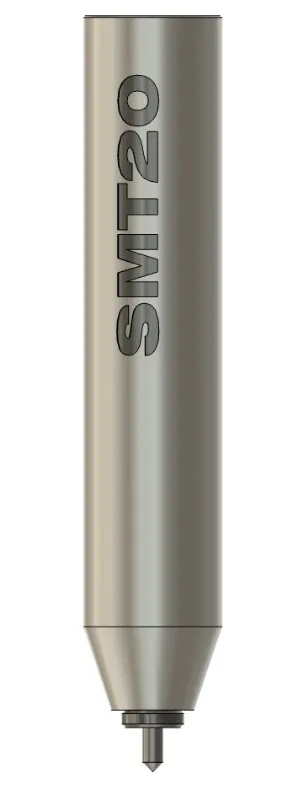
SMT20 Scratch Marking Tool
Spring-loaded carbide needle marks directly on the workpiece — no air supply, no coolant, no machine modification. Simply mount and mark.
- No air supply, no coolant, no external energy — purely mechanical marking
- 6 mm automatic distance compensation for uneven and curved surfaces
- Marks all machinable metals up to 60–62 HRC
- Fine, subtle marking — ideal for finished surfaces and thin-walled parts
- Compatible with all CNC control systems
Overview
Scratch Marking — The Simplest Way to Mark on a CNC Machine
SMT20 is a scratch marking tool (also called scribe marking tool) designed for automatic workpiece marking directly inside CNC machining centres and lathes. The tool sits in the automatic tool change magazine like any other cutting tool — when called by the CNC programme, it marks each workpiece with serial numbers, date codes, logos, or any alphanumeric text. Every part leaves the machine already marked.
The marking principle is purely mechanical: a spring-loaded carbide needle is pressed against the workpiece surface and dragged across it by the machine axes. The needle scratches a fine, continuous line into the material — clean, subtle, and permanent. Unlike dot peen or engraving, scratch marking creates minimal surface stress, making SMT20 the preferred choice for thin-walled workpieces, polished surfaces, and components where deep indentations are unacceptable.
The biggest advantage of SMT20 is its simplicity: no air supply, no coolant connection, no solenoid valves, no machine modification. Mount the tool, write the programme, and start marking. Built-in 6 mm distance compensation handles surface variations automatically — curved parts, uneven surfaces, and positional tolerances are absorbed by the spring mechanism.
For lathes with live tooling using an ER25 holder, AKS Teknik supplies a special ER25–20 mm collet so the tool fits directly in the live tool turret without any machine modification.
Product Photos
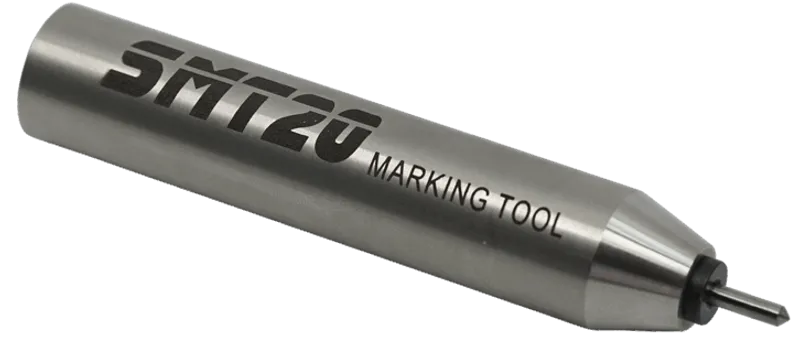
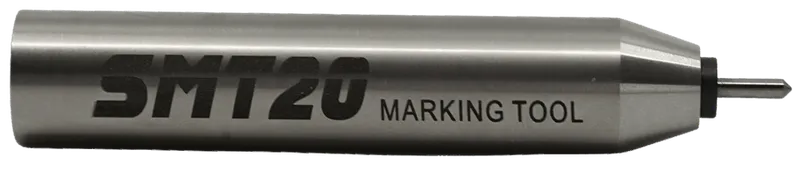
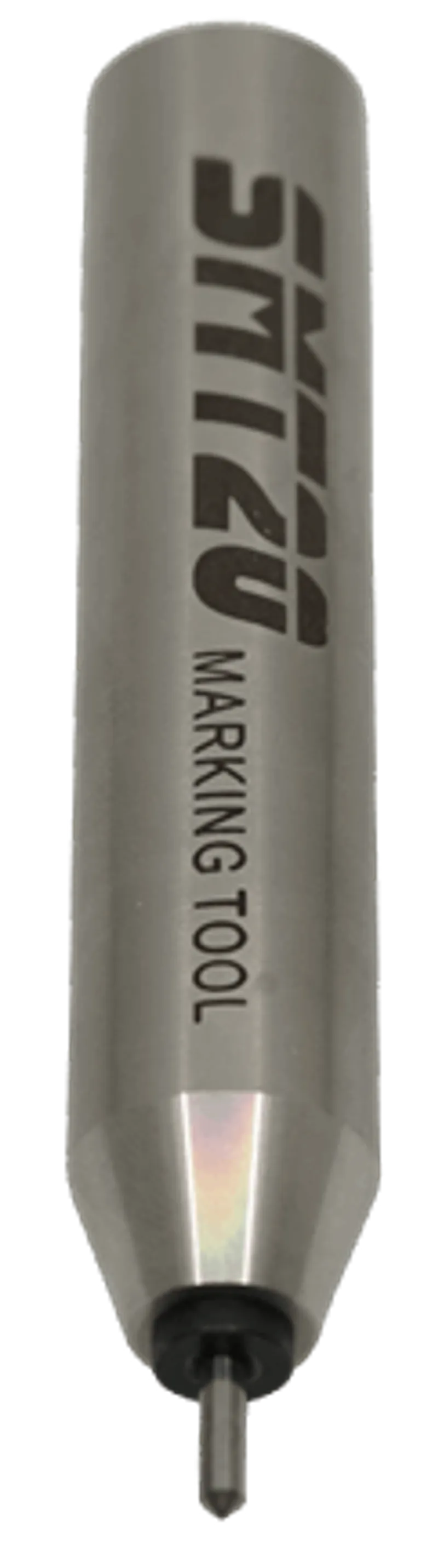
SMT20 Up Close
Advantages
Key Advantages
- No air, no coolant, no energy source — purely mechanical spring-driven marking; no machine modifications, no additional installations, no running costs
- Plug-and-play installation — mount in tool magazine, write the marking programme, and start marking; fastest installation of any marking tool on the market
- 6 mm distance compensation — built-in spring mechanism absorbs surface height variations; consistent marking on curved, uneven, and rough surfaces without Z-axis adjustment
- Fine, subtle marking — continuous scratch line with minimal surface stress; ideal for polished surfaces, thin-walled components, and parts where deep indentations are not acceptable
- Marks up to 60–62 HRC — carbide needle (90° tip, 0.3 mm radius) marks all machinable metals including hardened steel, stainless steel, cast iron, aluminium, and titanium
- Steplessly adjustable pressure — rear setscrew allows fine-tuning of spring load for different materials and marking depths; plus 1–2 mm infeed pre-tension for reliable contact
- All CNC systems compatible — works with Siemens, Heidenhain, Fanuc, and all other CNC controls; uses standard engraving cycles for programming
- Maintenance-free — no consumables, no lubrication, no wear parts except the replaceable carbide needle; zero running costs during normal operation
Specifications
Technical Specifications
| Parameter | Value |
|---|---|
| Order Code | 62.420.00 |
| Marking principle | Scratch (scribe) — spring-loaded needle dragged across surface |
| Drive | None — purely mechanical, spring-loaded |
| Air / coolant supply | Not required |
| Distance compensation | 6 mm |
| Max. marking depth | ~0.1 mm (material dependent) |
| Marking surface hardness | Up to 60–62 HRC |
| Pressure adjustment | Rear setscrew — steplessly adjustable spring load |
| Pressure on surface | 1–2 mm extra infeed (pre-tension) |
| Feed rate | F2000 mm/min |
| Spindle speed | 0 rpm (spindle stopped or minimum rotation) |
| Marking needle | Carbide, 90° tip, 0.3 mm radius (custom tips available on request) |
| Shank | Ø20 mm cylindrical |
| Body diameter | Ø20 mm |
| Total length | 102.5 mm |
| Recommended tool holder | ER32 or ER40 collet type (do not over-tighten Weldon holders) |
| CNC compatibility | All systems — Siemens, Heidenhain, Fanuc, etc. |
| Maintenance | Maintenance-free; needle replaceable |
How to Use
Setup and Operating Instructions
- 01
Install in CNC machine
Mount SMT20 in an ER32 or ER40 collet-type tool holder (Ø20 mm cylindrical shank) and place it in the automatic tool change magazine. No air or coolant connections are needed — the tool is ready to use immediately. For lathes with live tooling, use the optional ER25–20 mm collet supplied by AKS Teknik.
- 02
Set the marking pressure
Adjust the rear setscrew to set the desired spring pressure. Higher pressure produces a deeper, more visible scratch; lower pressure produces a finer line. Start with a medium setting and adjust based on test results on your material.
- 03
Position the tool on the workpiece
Move the tool down until the needle touches the workpiece surface, then advance 1–2 mm further to create pre-tension. This extra infeed ensures the needle maintains consistent contact throughout the marking cycle. The built-in 6 mm distance compensation absorbs surface variations automatically.
- 04
Run the marking programme
Execute the marking programme at F2000 mm/min feed rate with the spindle stopped (0 rpm). The CNC machine axes move the tool across the workpiece surface while the spring-loaded needle scratches the marking contour into the material.
- 05
Run production
With the marking position and pressure set, SMT20 marks each workpiece automatically as part of the CNC programme. No consumables, no maintenance, no additional handling — every part leaves the machine already marked.
Applications
Where SMT20 Excels
- Thin-walled components — minimal surface stress; no risk of deformation from deep indentations
- Polished and finished surfaces — fine scratch line preserves surface quality; no visible dot pattern
- Machines without air supply — no compressed air needed; ideal for older machines or simple setups without through-spindle air
- Serial numbers and date codes — individual part identification for traceability requirements (AS9100, IATF 16949)
Important
Tool Holder and Handling Notes
Do not over-tighten the tool holder
SMT20 has a thin wall thickness by design. Use an ER32 or ER40 collet-type tool holder — this distributes clamping force evenly around the circumference. If a Weldon-type holder must be used, do not over-tighten the locking screw — excessive clamping force can deform or damage the tool body.
FAQ
Frequently Asked Questions
- What is scratch marking and how does it work?
- Scratch marking (also called scribe marking) uses a spring-loaded carbide needle that is pressed against the workpiece surface and dragged across it by the CNC machine axes. The needle scratches a fine, continuous line into the material — similar to writing with a hard pen on metal. Unlike dot peen marking, which creates a series of indentations, scratch marking produces a single continuous groove. The marking is subtle, clean, and does not create chips or material removal in the conventional sense. SMT20 requires no air, no coolant, and no external energy source — only the spring mechanism inside the tool body.
- What materials can SMT20 mark?
- SMT20 marks virtually all machinable metals with surface hardness up to approximately 60–62 HRC — including steel, stainless steel, cast iron, aluminium, brass, copper, and titanium. The carbide needle (90° tip, 0.3 mm radius) is harder than the workpiece material, creating a fine scratch line under spring pressure. Marking depth is approximately 0.1 mm and varies depending on material hardness and the spring pressure setting.
- Does SMT20 require air or coolant supply?
- No. SMT20 is a purely mechanical tool — the marking needle is driven by an internal spring, not by air or coolant. This is the key advantage: no additional machine installations are required. No air lines, no coolant connections, no solenoid valves. Simply mount the tool in the tool magazine and call it from the CNC programme. This makes SMT20 the easiest marking tool to install on any CNC machine.
- When should I choose scratch marking instead of dot peen marking?
- Choose scratch marking when you need fine, subtle markings that do not create deep indentations — for example, on polished or finished surfaces where a visible dot pattern would be unacceptable. Scratch marking is also ideal for thin-walled workpieces because it creates less surface stress than micro-percussion. If you need deeper, more visible markings that are readable on rough cast or uneven surfaces, dot peen marking (PMT20AL) is the better choice.
- How is the marking pressure adjusted on SMT20?
- Marking pressure is adjusted via a rear setscrew on the tool body — the adjustment is stepless, allowing fine-tuning of the spring load for different materials and marking depths. Increasing the spring pressure produces a deeper, more visible scratch; reducing it produces a lighter, finer line. In addition, the tool is positioned with 1–2 mm extra infeed beyond surface contact to ensure consistent pre-tension during the marking cycle.
- Why does AKS Teknik recommend an ER32 or ER40 collet holder for SMT20?
- SMT20 has a thin wall thickness by design — the tool body must be lightweight to allow the spring mechanism to function properly. A Weldon-type tool holder with a set screw can deform or damage the tool body if over-tightened. An ER32 or ER40 collet-type holder distributes the clamping force evenly around the entire circumference, holding the tool securely without risk of damage. If a Weldon holder must be used, the locking screw should be tightened with care — do not over-tighten.
Video
SMT20 in Action
SMT20 scratch marking tool in action on a CNC machine. The spring-loaded carbide needle marks the workpiece surface under controlled spring pressure — no air supply, no coolant, no external energy source required. The marking contour is moved by the CNC machine axes while the spindle remains stopped.
SMT20 scratch marking tool demonstration — spring-loaded carbide needle creates fine, permanent markings on the workpiece surface. No air or coolant supply needed, purely mechanical operation.
Downloads
Documentation
Related Products
Other Marking Tools
Looking for the right marking solution for your CNC machine?
Our engineers will help you choose the best marking method — dot peen, scratch or hydraulic — for your material, depth and cycle time requirements.
Contact Us