
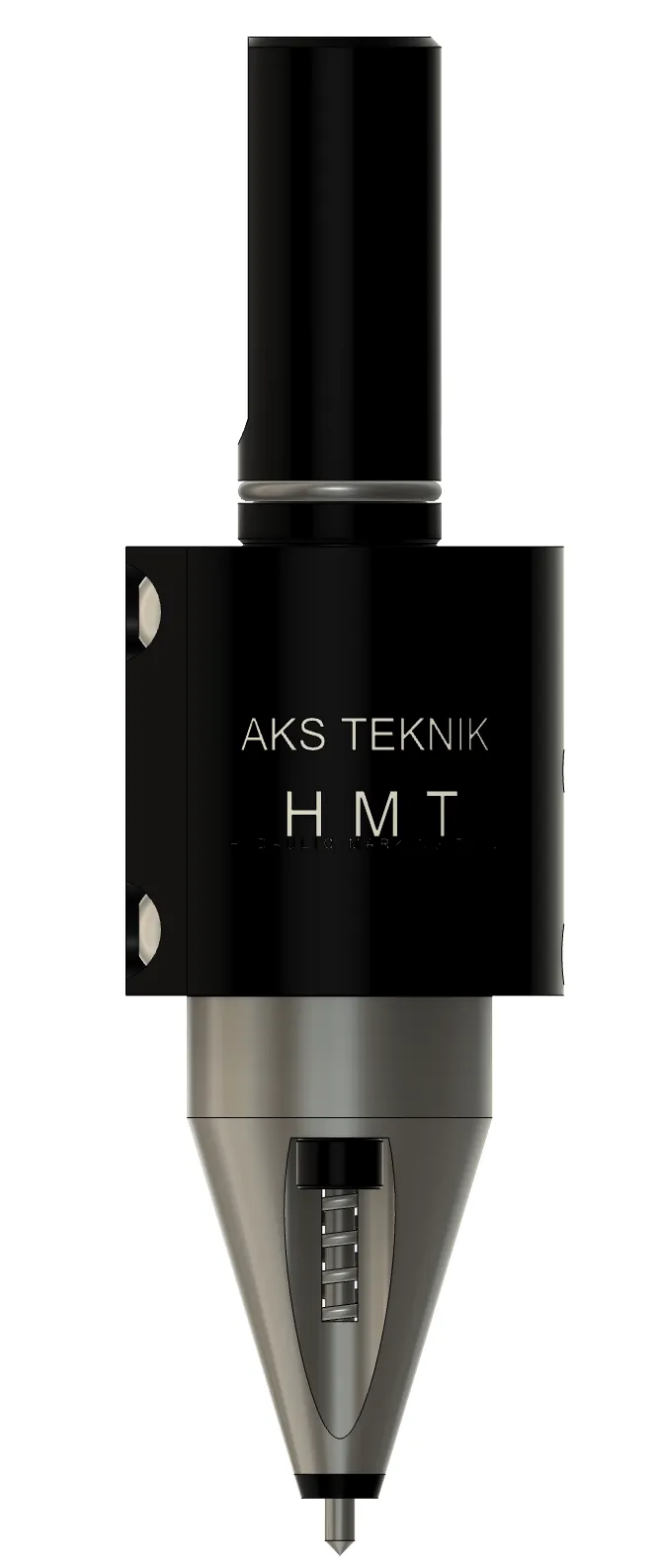
HMT20 Coolant-Driven Marking Tool
Dot peen marking powered by through-spindle coolant — no air supply needed. If your machine has TSC, you already have everything required to mark.
- Powered by through-spindle coolant — no air supply, no external connections
- Works with emulsion and oil, 15–70 bar coolant pressure
- 3–4 mm automatic distance compensation
- Marks all machinable metals up to 60–62 HRC
- Compatible with all CNC control systems
Overview
Dot Peen Marking — Powered by Your Machine's Coolant System
HMT20 is a coolant-driven dot peen marking tool designed for CNC machining centres equipped with through-spindle coolant (TSC). The tool uses the machine's existing internal cooling system — emulsion or oil at 15–70 bar — to drive a micro-percussion marking needle. No air supply, no external valves, no additional machine installations required.
The marking principle is micro-percussion: a carbide-tipped needle oscillates vertically at approximately 300 Hz, driven by coolant pressure. Each oscillation creates a fine indentation on the workpiece surface. The dots are placed so close together that the result appears as a continuous line. Like all dot peen marking, the process compresses the material rather than removing it — no chips, no fibre damage, no weakening of the workpiece structure.
The name "Hydraulic" in HMT refers to the pressurised fluid activation — the tool is driven by the coolant flowing through the spindle, not by a hydraulic cylinder. If your machine already has through-spindle coolant with at least 15 bar, HMT20 is ready to use immediately — mount it in the tool magazine, write the programme, and start marking. For machines without TSC, see the air-driven PMT20AL.
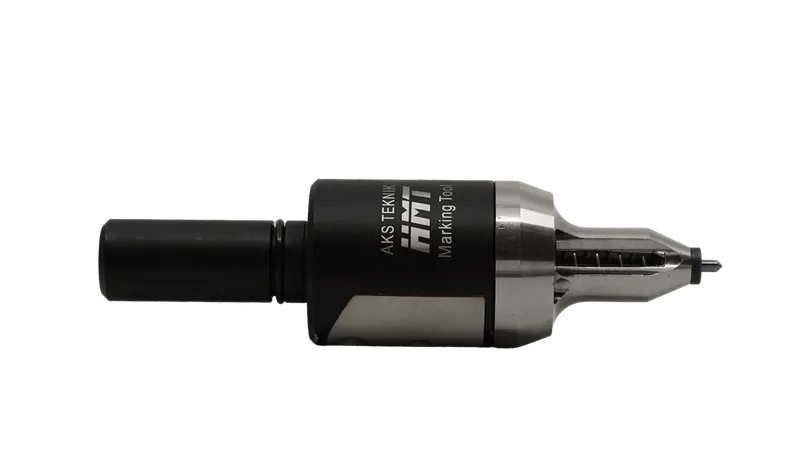
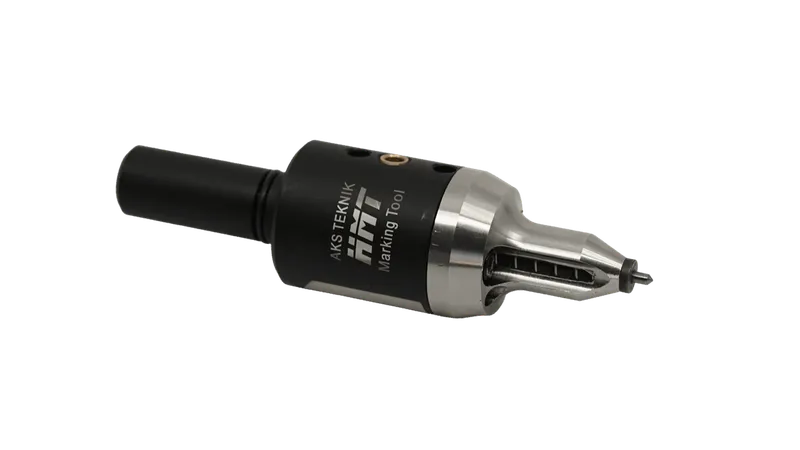
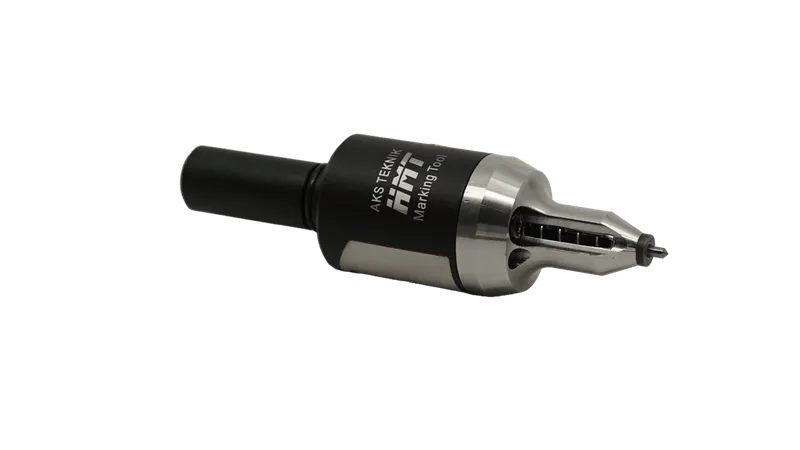
Product Photos
HMT20 Up Close
Advantages
Key Advantages
- No air supply needed — powered entirely by through-spindle coolant; if your machine has TSC, no additional installations are required
- Works with emulsion and oil — compatible with all standard CNC coolant types at 15–70 bar pressure
- No separate marking step — marking is integrated into the CNC programme; every workpiece is marked automatically during production
- No material weakening — micro-percussion compresses the surface without severing material fibres; safe for thin-walled and safety-critical components
- 3–4 mm distance compensation — built-in mechanism absorbs surface height variations; consistent marking on curved and uneven surfaces
- Marks up to 60–62 HRC — carbide needle marks all machinable metals including hardened steel, stainless steel, cast iron, aluminium, and titanium
- All CNC systems compatible — works with Siemens, Heidenhain, Fanuc, and all other CNC controls; standard engraving cycles for programming
- Maintenance-free — virtually wear-free carbide needle, replaceable; no consumables, no lubrication required
Specifications
Technical Specifications
| Parameter | Value |
|---|---|
| Order Code | 64.420.00 |
| Marking principle | Micro-percussion (dot peen) — coolant-driven needle oscillation |
| Drive | Through-spindle coolant (TSC) — emulsion or oil |
| Coolant pressure | 15–70 bar |
| Needle frequency | ~300 Hz |
| Distance compensation | 3–4 mm |
| Max. marking depth | ~0.2 mm (material and pressure dependent) |
| Marking surface hardness | Up to 60–62 HRC |
| Feed rate | F3000 mm/min (adjustable) |
| Marking time | ~1 second per character |
| Spindle speed | 0 rpm (spindle stopped) |
| Marking needle | Carbide, 90° tip, 0.3 mm radius (custom tips available on request) |
| Shank | Ø20 mm Weldon |
| Shank length | 50 mm |
| Body diameter | Ø44 mm |
| Lower section | Ø30 mm |
| Total length | 149 mm |
| Machine requirement | Through-spindle coolant (TSC), min. 15 bar |
| CNC compatibility | All systems — Siemens, Heidenhain, Fanuc, etc. |
| Maintenance | Maintenance-free; needle replaceable |
How to Use
Setup and Operating Instructions
- 01
Install in CNC machine
Mount HMT20 in a Weldon tool holder (Ø20 mm shank) and place it in the automatic tool change magazine. The tool receives coolant through the spindle — no external air or coolant connections are needed.
- 02
Set the initial marking position
Position the marking needle 6 mm away from the workpiece surface. Activate the through-spindle coolant and run the marking programme — no marking should be visible at this distance. If marking appears, reduce coolant pressure.
- 03
Find the correct marking depth
Advance the tool 0.5 mm closer to the workpiece and run the marking cycle again. Repeat in 0.5 mm increments until marking becomes visible. Then advance one final 0.5 mm to ensure complete, well-formed marking. Minimum safe distance: 1 mm.
- 04
Optimise approach speed
Approach the marking position at maximum rapid traverse speed. This minimises the first-dot-deeper effect — when the machine transitions from rapid approach to marking feed, the needle strikes the first point multiple times if the transition is slow.
- 05
Run production
With the marking position set, HMT20 marks each workpiece automatically as part of the CNC programme. Every part leaving the machine is already marked — no separate marking step, no manual handling.
Applications
Where HMT20 Excels
- Machines with through-spindle coolant — no additional installations needed; the existing coolant system powers the marking tool
- Machines without air supply — ideal when compressed air is not available through the spindle or difficult to install
- Serial numbers and traceability — individual part identification for aerospace (AS9100) and automotive (IATF 16949) requirements
- High-volume production — automatic in-process marking at ~1 second per character; minimal impact on cycle time
Comparison
HMT20 vs PMT20AL — Which Marking Tool Do I Need?
| HMT20 | PMT20AL | |
|---|---|---|
| Drive | Through-spindle coolant | Compressed air |
| Pressure | 15–70 bar coolant | 5–8 bar air |
| Machine requirement | TSC system | Air supply (through spindle or lateral) |
| Needle frequency | ~300 Hz | ~300 Hz |
| Max. hardness | 60–62 HRC | 60–62 HRC |
| Distance compensation | 3–4 mm | 3–5 mm |
| Best for | Machines with TSC, no air available | Any machine with air supply |
FAQ
Frequently Asked Questions
- What is coolant-driven marking and how does HMT20 work?
- HMT20 uses the machine's through-spindle coolant (TSC) system to drive a micro-percussion marking needle. When coolant pressure (emulsion or oil, 15–70 bar) is activated, the carbide needle oscillates vertically at approximately 300 Hz, creating closely spaced indentations on the workpiece surface. The CNC machine axes move the tool across the marking contour while the spindle remains stopped (0 rpm). The result is a permanent, deep dot peen marking — identical in principle to air-driven marking, but powered by coolant instead of compressed air.
- Why choose coolant-driven marking instead of air-driven marking?
- If your CNC machine already has a through-spindle coolant system (TSC), HMT20 requires no additional installation — no air lines, no solenoid valves, no external connections. The coolant supply that is already built into your machine drives the marking needle directly. This makes HMT20 the simplest marking solution for machines with TSC. If your machine does not have through-spindle coolant, the air-driven PMT20AL is the alternative.
- What coolant types and pressures does HMT20 support?
- HMT20 works with both emulsion and oil as coolant medium. The operating pressure range is 15–70 bar. A minimum of 15 bar through-spindle coolant pressure is required for the marking needle to oscillate reliably. Higher coolant pressure produces deeper marking — the marking depth can be influenced by adjusting the machine's coolant pressure setting.
- What materials can HMT20 mark?
- HMT20 marks all machinable metals with surface hardness up to approximately 60–62 HRC — including steel, stainless steel, cast iron, aluminium, brass, copper, and titanium. The micro-percussion process compresses the material surface without removing it, making HMT20 suitable for hardened workpieces and safety-critical components.
- Can HMT20 mark curved or uneven surfaces?
- Yes. HMT20 has 3–4 mm built-in distance compensation. The internal mechanism absorbs surface height variations during marking, producing consistent marking depth on slightly curved, uneven, or rough surfaces without Z-axis adjustment in the CNC programme.
- What machine requirements does HMT20 need?
- HMT20 requires a CNC machine with a through-spindle coolant (TSC) system delivering a minimum of 15 bar coolant pressure. The tool mounts via a standard Ø20 mm Weldon shank in the automatic tool change magazine. HMT20 is compatible with all CNC control systems — Siemens, Heidenhain, Fanuc, and others.
Videos
HMT20 in Action
HMT20 coolant-driven marking tool in action — the through-spindle coolant activates the carbide needle, creating permanent dot peen markings on the workpiece surface. No air supply required, powered entirely by the machine coolant system.
HMT20 hydraulic marking tool demonstration on a CNC machining centre. The tool uses through-spindle coolant to drive the micro-percussion needle — marking directly during the machining cycle with no separate marking step.
Downloads
Documentation
Related Products
Other Marking Tools
Looking for the right marking solution for your CNC machine?
Our engineers will help you choose the best marking method — dot peen, scratch or hydraulic — for your material, depth and cycle time requirements.
Contact Us