
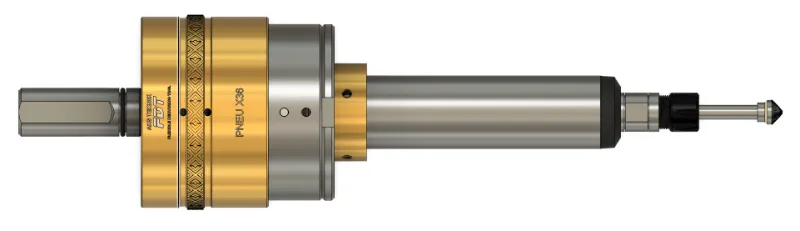
FDT PNEUMATIC X36 Robotic Deburring Tool
Pneumatic robotic deburring tool with self-contained air motor and 12 mm lateral spring compliance. Mounts to any robot arm or bench — no CNC spindle required.
- 12 mm lateral spring compliance — follows undefined workpiece edges automatically
- Self-contained pneumatic motor — no CNC spindle required
- Mounts to any robot arm or bench via 20 mm Weldon flat shank
- Spring-based lateral force — consistent chamfer quality independent of air pressure fluctuations
Overview
Pneumatic Robotic Deburring — Self-Contained Air Motor with Lateral Spring Compliance
FDT PNEUMATIC X36 is an air-driven robotic deburring tool with a self-contained pneumatic motor and built-in lateral spring compliance. Unlike spindle-mounted deburring tools that draw their rotation from the CNC machine spindle, FDT PNEUMATIC X36 has its own internal air motor — the tool mounts to a robot arm or bench via a 20 mm Weldon flat shank, and the cutter rotation is powered entirely by the compressed air supply connected at the rear.
The tool is fitted with a 30,000 rpm / 350W lubricated-air spindle, driving the cutter through an ER-11 collet and accepting standard industrial carbide burrs and profiles with shank diameters from ⌀0.5 mm to ⌀7 mm. The high spindle speed produces particularly clean results on aluminium — the combination of fast cutter rotation and lateral spring compliance delivers consistent, burr-free edges on aluminium components without secondary manual operations.
A built-in spring provides 12 mm of lateral compliance — the cutter assembly can deflect laterally by up to 12 mm, following the natural variation of workpiece edges without requiring the robot programme to compensate for every positional deviation. Lateral contact pressure is adjustable via a built-in mechanism, allowing the chamfer width and cutting force to be tuned to the material and edge condition.
A key design feature is that the lateral spring force is generated mechanically, not by air pressure. This means chamfer consistency is maintained even when supply air pressure fluctuates — a common limitation of tools that use air pressure directly for lateral compliance. FDT PNEUMATIC X36 is designed for use with lubricated compressed air (8.3 l/sec, 1/8" Gas connection, 6 mm hose inside diameter).
Advantages
Key Advantages
- No CNC spindle required — self-contained air motor mounts to any robot arm or bench via 20 mm Weldon flat shank; no machine modification needed
- 12 mm lateral spring compliance — cutter follows undefined or variable workpiece edges without reprogramming the robot path for each edge variation
- Spring-based lateral force — chamfer width and contact force remain consistent even when air supply pressure fluctuates during production
- Steplessly adjustable contact pressure — rotate the outer gold-coloured ring to set chamfer aggressiveness continuously; no tools, no disassembly required
- ER-11 collet system — accepts standard industrial carbide burrs from ⌀0.5 mm to ⌀7 mm; compatible with all standard burr geometries and profiles
- 30,000 rpm / 350W spindle — high speed delivers clean chamfering, particularly effective on aluminium workpieces
- Designed for automation — compatible with any robot with ≥ 3 kg payload capacity; also suitable for automated deburring lines and bench-mounted stations
Specifications
Technical Specifications
| Parameter | Value |
|---|---|
| Order Code | 30.420.00 |
| Drive type | Pneumatic — self-contained air motor (no CNC spindle required) |
| Deflection type | Lateral (XY plane) — spring compliance |
| Max. lateral deflection | 12 mm |
| Lateral pressure adjustment | Built-in mechanism — adjustable to control chamfer width and contact force |
| Spindle speed | 30,000 rpm |
| Power | 350 W |
| Rotation | Clockwise |
| Collet | ER-11 — accepts carbide burrs ⌀0.5 mm to ⌀7 mm |
| Mounting shank | 20 mm Weldon flat |
| Air supply | Required — lubricated air (oil mist lubrication) |
| Air consumption | 8.3 l/sec |
| Air connection | 1/8" Gas — from rear |
| Air hose (ID) | 6 mm |
| Noise level | 78 dB |
| Tool weight | approx. 2.5 kg |
| Custom configurations | Special versions (e.g. side air inlet) available on request — contact AKS Teknik. |
How to Use
Operating Instructions
- 01
Mount to robot arm or bench
Insert the 20 mm Weldon flat shank into the robot tool flange or bench holder and secure. Lateral deburring forces are transmitted through the shank, so clamping must be solid. Verify the air connection port at the rear of the tool body is accessible for hose connection.
12 mm Lateral Spring Compliance - 02
Connect lubricated compressed air
Connect the air supply hose (6 mm inside diameter) to the 1/8" Gas port at the rear of the tool. Always use lubricated air (oil mist lubrication) — the internal air motor requires oil mist for reliable operation and long service life.
- 03
Set lateral contact pressure
Rotate the outer gold-coloured ring on the tool body to set contact pressure — clockwise to increase, counter-clockwise to decrease. The adjustment is stepless and requires no tools. Increase pressure for harder materials (steel, cast iron) or heavier edge burrs; reduce it for aluminium, brass, or fine edges on thin-wall features. Make a test pass and inspect the chamfer width before running production.
- 04
Fit the carbide burr
Select a carbide burr geometry suited to the workpiece edge profile. Insert the shank into the ER-11 collet and tighten the collet nut. Confirm the burr runs true before engaging the workpiece — runout increases chamfer unevenness and accelerates cutter wear.
- 05
Program the robot path and run
Program the robot to follow the edge at a consistent feed speed. The 12 mm lateral spring compliance absorbs positional deviations automatically — the path does not need to be precisely calibrated to each edge location. Consistent feed speed is the primary factor for consistent chamfer width. Run a test cycle on a sample part, inspect chamfer quality and uniformity, then adjust pressure or feed as needed before running production.
Cutter Selection
Compatible Carbide Burrs
FDT PNEUMATIC X36 uses an ER-11 collet and accepts standard industrial carbide burrs and profile tools with shank diameters from ⌀0.5 mm to ⌀7 mm. Cutter geometry selection depends on the workpiece edge profile, contour shape, and required chamfer width.
| Cutter Type | Characteristics | Use Case |
|---|---|---|
| Ball (spherical) carbide burr Shank ⌀6 mm | Spherical cutting head — self-aligns on edges from any lateral approach angle; effective in all directions | General-purpose robotic deburring; profiled or curved edges; contours where approach angle varies around the part |
| Cylindrical carbide burr Shank ⌀6 mm | Cylindrical cutting head — effective for flat edge deburring along straight runs | Straight edge deburring on flat faces; consistent edge height; use where edge profile is uniform |
| 90° conical carbide burr Shank ⌀6 mm | Produces a defined chamfer on the edge corner | Chamfering milled or turned edges where a defined chamfer angle is required |
| Custom profile cutters Standard industrial profiles | Specialty geometries for specific edge profiles, radii, or form features | Application-specific deburring where standard geometries do not match the workpiece edge — contact AKS Teknik |
Contact AKS Teknik for cutter recommendations for your specific application, material, and robot system.
FAQ
Frequently Asked Questions
-
What is FDT PNEUMATIC X36 and how does it differ from spindle-mounted deburring tools?
FDT PNEUMATIC X36 is a pneumatic robotic deburring tool with a self-contained air motor — it does not require a CNC machining centre spindle to drive the cutter. The tool body mounts to a robot arm or bench via a 20 mm Weldon flat shank, and the cutter rotation is powered entirely by the compressed air supply. A built-in spring provides 12 mm of lateral compliance, allowing the cutter to follow undefined or variable workpiece edges automatically. By contrast, spindle-mounted tools like FDT SX0 draw their rotation from the machine spindle — FDT PNEUMATIC X36 supplies its own drive and is designed for robot-mounted or bench-mounted deburring applications where no CNC spindle is available.
-
Does FDT PNEUMATIC X36 require a CNC spindle?
No. FDT PNEUMATIC X36 has a self-contained pneumatic (air-driven) motor. The tool mounts to the robot arm or bench via a 20 mm Weldon flat shank — the shank provides mechanical mounting only, not drive. Cutter rotation is powered entirely by the compressed air supply connected to the 1/8" Gas port at the rear of the tool. This makes FDT PNEUMATIC X36 suitable for any robot arm, automated deburring fixture, or bench station that can supply lubricated compressed air.
-
How does the lateral pressure adjustment work on FDT PNEUMATIC X36?
Contact pressure is set by rotating the outer gold-coloured ring on the tool body — clockwise to increase pressure, counter-clockwise to reduce it. The adjustment is stepless and can be made without tools or disassembly. Increasing contact pressure produces a wider, more aggressive chamfer; reducing it produces a narrower, lighter chamfer. The spring-based compliance absorbs workpiece geometry variations — edge-to-edge height changes, surface irregularities, and positional deviations from the robot path — without requiring the robot programme to be corrected for each part. The lateral force is generated by the spring, not by air pressure directly, so chamfer consistency is maintained even when air supply pressure fluctuates.
-
Why is spring-based lateral force better than direct air-pressure deflection?
When the lateral deflection force is generated by a spring, it remains constant regardless of air supply pressure variations. Industrial compressed air systems are subject to pressure fluctuations from simultaneous tool use, line length, or compressor output changes. If the lateral force were created directly by air pressure, every fluctuation would change the chamfer width and deburring aggressiveness. With FDT PNEUMATIC X36's spring-based lateral mechanism, the contact force is set by the spring preload — not the air pressure — so chamfer quality remains consistent across an entire production run even when supply pressure varies.
-
What payload capacity does a robot need to carry FDT PNEUMATIC X36?
FDT PNEUMATIC X36 weighs approximately 2.5 kg, so a robot with a 3 kg payload capacity is sufficient — no heavy-duty robot arm is required. The tool mounts via a 20 mm Weldon flat shank and connects to the air supply at the rear. It is compatible with robot-mounted deburring cells, automated deburring lines, and bench-mounted deburring stations. The Weldon flat shank is a general industrial interface and is not exclusive to robots — any fixture or holder that accepts a 20 mm shank can be used.
-
What carbide burrs are compatible with FDT PNEUMATIC X36?
FDT PNEUMATIC X36 uses an ER-11 collet and accepts standard industrial carbide burrs and profile tools with shank diameters from ⌀0.5 mm to ⌀7 mm. Any standard carbide burr or profile cutter with an ER-11-compatible shank fits directly. Cutter geometry selection (spherical, cylindrical, conical, or custom profile) depends on the workpiece edge type, contour geometry, and required chamfer width. Contact AKS Teknik for cutter recommendations for your specific application.
Applications
Typical Industries & Applications
Robot-Mounted Deburring Cells
Automating deburring by mounting FDT PNEUMATIC X36 on a robot arm. The robot follows the programmed path while the 12 mm lateral spring compliance compensates for edge and positional variations automatically — without reprogramming for each part. Suitable for casting, forging, and machined part deburring at production scale.
Automated Deburring Lines
Integration into automated manufacturing lines where parts are presented to a fixed deburring station. The spring-based compliance handles part-to-part geometry variation within the 12 mm range without mechanical adjustment between cycles. Particularly effective for high-volume production of castings, forgings, and press-formed parts with consistent but not identical edge profiles.
Bench-Mounted Deburring Stations
Semi-automated bench deburring where the operator presents the workpiece to the mounted tool. The Weldon flat shank allows rigid mounting in a bench fixture, and the pneumatic motor provides high-speed cutting without any electrical connection at the workpoint. Effective for small-batch production and rework deburring where full robot integration is not required.
Videos
FDT PNEUMATIC X36 in Action
Downloads
Technical Documents
Related Products
Other Deburring Tools
Ready to automate your deburring process?
Our engineers will help you select the right tool for your application and material.
Contact Us