
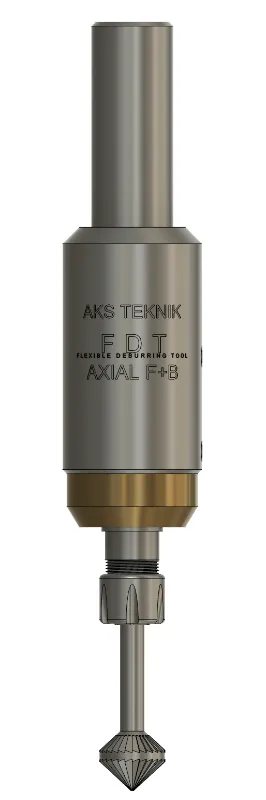
FDT AXIAL (F+B) Deburring Tool
Combined push-pull axial deburring tool — handles front-face and back-face deburring with a single tool. No tool change, no workpiece repositioning, no air supply required.
- 8 mm push + 8 mm pull — front and back face without a tool change
- Spindle-driven — no air supply, no extra infrastructure
- Steplessly adjustable contact pressure — continuous fine-tuning for any material
- Eliminates tool change and workpiece repositioning for two-sided deburring
Overview
Push-Pull Axial Deburring — Front and Back Face Without a Tool Change
FDT AXIAL (F+B) is a spindle-driven combined push-pull deburring tool that brings together the mechanisms of FDT AXIAL (F) and FDT AXIAL (B) into a single compact body. It deburrs both the front face and the back face of holes, bores, and through-features automatically in the CNC cycle — without a tool change and without repositioning the workpiece.
The tool provides 8 mm of axial stroke in each direction: 8 mm push (spring compresses upward, for front-face entry deburring) and 8 mm pull (spring extends downward, for back-face exit deburring). The programme first runs the tool along the top or entry-side contour — the push spring engages and deburrs the front edge. The programme then moves to the bottom or exit-side contour — the pull spring engages and deburrs the back edge. Both operations use the same tool in the same CNC cycle, with no tool change.
Contact pressure is steplessly adjustable via a built-in mechanism — the tool ships pre-set to a recommended pressure, and can be increased or decreased continuously without disassembly. Program the Z-axis so the tool tip sits 1–2 mm past the back face (highest Z / closest to spindle) and the tool handles both faces automatically.
When machining top or front-face contours, FDT AXIAL (F+B) operates identically to FDT AXIAL (F) — the push mechanism compresses and the tool compensates upward. When machining bottom or back-face contours, it operates identically to FDT AXIAL (B) — the pull mechanism extends the cutter assembly downward. The tool can therefore be used as a direct replacement for FDT AXIAL (F) or FDT AXIAL (B) individually, with cutter selection determining the effective operation mode.
FDT AXIAL (F+B) uses an ER-11 collet. For full push-pull operation, AKS Teknik offers a special diamond-shaped bidirectional deburring cutter (sold separately) that cuts effectively in both directions. Ball (spherical) carbide burrs are also suitable for both top and bottom contours. When used for single-direction deburring, the standard 90° conical burr (front face) or inverted cone burr (back face) applies — the same cutters used with FDT AXIAL (F) and FDT AXIAL (B) respectively.
Advantages
Key Advantages
- Both faces without a tool change — push for the front-face entry contour, pull for the back-face exit contour; same tool, same CNC cycle, no tool swap
- 8 mm stroke in each direction — sufficient for the majority of production deburring applications on both faces
- Steplessly adjustable contact pressure — fine-tune chamfer depth and cutting force continuously via the built-in mechanism; no spring swapping required
- No air supply required — spindle-driven, no pneumatic infrastructure needed
- Reduces cycle time and setups — replaces two separate operations (FDT AXIAL-F + FDT AXIAL-B) with a single tool in one cycle
- Compatible with CNC machines and robots — fits any tool holder accepting a 20 mm cylindrical or Weldon flat shank
- ER-11 collet system — ships with 6 mm collet as standard (⌀1–7 mm; 6.4 mm / ¼" collet available for US customers on request); compatible with diamond-shape bidirectional, ball, 90° cone and inverted cone carbide cutters
- Concordant milling in both directions — climb milling on both push and pull strokes for a clean chamfer finish and reduced cutter wear
Specifications
Technical Specifications
| Parameter | Value |
|---|---|
| Order Code | 23.420.00 |
| Activation | Via machine spindle (CNC machining centres, NC machines, robots) |
| Deflection type | Axial — push + pull (Z-axis direction, both directions) |
| Max. axial stroke | 8 mm push (compression) + 8 mm pull (extension) |
| Spindle speed | 6,000–8,000 rpm |
| Feed rate | 2,000–4,000 mm/min |
| Z-axis offset | 1–2 mm past back face (highest Z coordinate / closest to spindle) |
| Milling direction | Concordant — clockwise spindle rotation |
| Contact pressure | Steplessly adjustable via built-in mechanism — tool ships pre-set; increase or decrease as needed without disassembly |
| Collet | ER-11 — ships with 6 mm collet as standard (accepts ⌀1–7 mm collets; 6.4 mm / ¼" collet available for US customers on request) |
| Shank | 20 mm cylindrical (standard). Weldon flat available on request. |
| Air supply | Not required |
| Variants & options | Standard tool: ER-11 collet, Ø20 mm shank (order code 23.420.00). ER-16 and ER-20 collet versions available as custom order — contact AKS Teknik. Larger-body models manufactured to special order on request. |
How to Use
Operating Instructions
- 01
Set contact pressure via the built-in adjustment mechanism
Use the built-in stepless adjustment mechanism to set contact pressure. The tool ships pre-set to a recommended starting pressure — in many cases no adjustment is needed before the first test pass. Increase pressure for steel, cast iron, or heavier burrs; reduce it for aluminium, brass, or fine edges. Unlike FDT AXIAL (B), no spring swapping is required: pressure can be set continuously across the full range.
- 02
Set the Z-axis offset — 1–2 mm past the back face
Program the Z-axis so the tool tip is 1–2 mm past the back face of the feature (highest Z coordinate, the point closest to the spindle). This pre-loads the pull spring for back-face deburring. As the tool follows the programmed path, the push spring engages automatically when the cutter contacts the front-face entry edge.
Push & Pull — One Tool, No Tool Change - 03
Set cutting direction — clockwise
Program the spindle to rotate clockwise (M03). FDT AXIAL (F+B) is designed for concordant (climb) milling in both push and pull directions, producing a clean chamfer on both faces with lower cutting forces and reduced cutter wear.
- 04
Set spindle speed and feed rate
Recommended range: 6,000–8,000 rpm at F2,000–4,000 mm/min. For aluminium, use the upper end of the speed range with cutting fluid. For steel, start mid-range. Keep feed rate constant throughout the cycle — feed variation causes uneven chamfer width on both faces. Inspect both the front and back chamfer after the first test pass and adjust Z-offset or contact pressure as needed.
- 05
Verify both chamfers and adjust
Run a single pass and inspect both the front-face chamfer (push side) and the back-face chamfer (pull side). If the front chamfer is insufficient, move the Z-offset slightly away from the spindle. If the back chamfer is insufficient, move the Z-offset slightly toward the spindle. Adjust one parameter at a time and run a test pass after each change.
Cutter Selection
Recommended Deburring Cutters for FDT AXIAL (F+B)
FDT AXIAL (F+B) uses an ER-11 collet and ships with a 6 mm collet as standard — accepting carbide cutters with shank diameters from ⌀1 mm to ⌀7 mm (6.4 mm / ¼" collet available for US customers on request). Cutter selection depends on the operation mode (F+B combined, F-only, or B-only) and part geometry.
| Cutter Type | Characteristics | Use Case |
|---|---|---|
| Diamond-shape bidirectional carbide burr Shank 6 mm — sold separately | Special geometry developed for F+B operation — cuts effectively in both push (front face) and pull (back face) directions | Recommended for full F+B combined operation. Ideal for two-sided chamfering where both faces must be deburred without a tool change. Available from AKS Teknik on request. |
| Ball (spherical) carbide burr Shank 6 mm | Spherical cutting head — self-aligns on edges from any direction; cuts in both push and pull | Suitable for both top and bottom contour deburring, especially on curved or profiled surfaces. Also works for F+B combined operation. Available from AKS Teknik on request. |
| 90° conical carbide burr Shank 6 mm | Standard cone geometry (pointing down) — same cutter used with FDT AXIAL (F) and FDT SX0 | Use when operating FDT AXIAL (F+B) as an FDT AXIAL (F) replacement — front-face and top-entry deburring only. The push mechanism is active; pull stroke is not used. |
| Inverted cone carbide burr Shank 6 mm | Inverted cone geometry (wide at cutting face, narrow toward shank) — same cutter used with FDT AXIAL (B) | Use when operating FDT AXIAL (F+B) as an FDT AXIAL (B) replacement — back-face and underside deburring only. The pull mechanism is active; push stroke is not used. |
Contact AKS Teknik for cutter availability and recommendations for your specific application and part geometry.
FAQ
Frequently Asked Questions
-
What is FDT AXIAL (F+B) and how does it compare to FDT AXIAL (F) and FDT AXIAL (B)?
FDT AXIAL (F+B) is a combined push-pull axial deburring tool that integrates both mechanisms in a single body. FDT AXIAL (F) is push-only — 10 mm stroke — for front-face and entry-side deburring. FDT AXIAL (B) is pull-only — 10 mm stroke — for underside and back-face deburring. FDT AXIAL (F+B) provides 8 mm of stroke in each direction (8 mm push + 8 mm pull) from a single tool, enabling both faces to be deburred in the same CNC cycle — no tool change, no workpiece repositioning.
-
Can FDT AXIAL (F+B) deburr both faces of a hole without a tool change?
Yes — this is the principal advantage of FDT AXIAL (F+B). The programme first runs the tool along the top or entry-side contour: the push spring engages and deburrs the front-face edge. The programme then moves to the bottom or exit-side contour: the pull spring engages and deburrs the back-face edge. Both chamfers are produced with the same tool in the same CNC cycle — no tool change, no workpiece repositioning. The saving over using separate FDT AXIAL (F) and FDT AXIAL (B) tools is: one fewer tool in the magazine, no tool-change move, and a simpler deburring programme.
-
What is the stroke of FDT AXIAL (F+B) compared to FDT AXIAL (F) and FDT AXIAL (B)?
FDT AXIAL (F+B) provides 8 mm of axial travel in each direction — 8 mm push and 8 mm pull. The standalone FDT AXIAL (F) and FDT AXIAL (B) each provide 10 mm in their respective single direction. The F+B stroke per direction is slightly shorter because both spring mechanisms share the same tool body. For the majority of production deburring applications, 8 mm per direction is sufficient to compensate for edge variations, surface irregularities, and height deviations on both faces.
-
How do I set the Z-axis offset for FDT AXIAL (F+B)?
Program the Z-axis so the tool tip sits 1–2 mm past the back face (highest Z coordinate — the point closest to the spindle). This pre-loads the pull mechanism for back-face deburring while leaving the push mechanism available to engage when the cutter contacts the front-face entry edge. Exact Z-offset depends on the workpiece geometry and contact pressure setting. Contact AKS Teknik for application-specific setup guidance.
-
What deburring cutters are compatible with FDT AXIAL (F+B)?
FDT AXIAL (F+B) uses an ER-11 collet and ships with a 6 mm collet as standard — accepting carbide cutters with shank diameters from ⌀1 mm to ⌀7 mm (6.4 mm / ¼" collet available for US customers on request).
For full push-pull combined operation (both faces without a tool change), AKS Teknik offers a special diamond-shaped bidirectional deburring cutter designed specifically for F+B operation — it cuts effectively in both the push and pull directions and is sold separately. Ball (spherical) carbide burrs are also suitable for both top and bottom contour deburring.
The tool can also be used for single-direction deburring: use a 90° conical burr when replacing FDT AXIAL (F) for front-face deburring, or an inverted cone burr when replacing FDT AXIAL (B) for back-face and underside deburring. Cutter selection depends on part geometry and contour position. -
Can FDT AXIAL (F+B) be used on CNC lathes?
Yes. FDT AXIAL (F+B) is compatible with CNC machining centres, NC machines, turning centres, and robots — any machine that accepts a 20 mm shank tool. No compressed air supply is required. For lathes with live tooling using an ER25 holder, AKS Teknik supplies a special ER25–20 mm collet so the tool fits directly in the live tool turret without machine modification. Weldon flat shank available on request.
Applications
Typical Industries & Workpieces
Through-Hole Two-Sided Chamfering
Deburring both the entry and exit edges of through-holes with a single tool — no tool change between the top-entry chamfer (push) and the bottom-exit chamfer (pull), and no need to flip or reposition the workpiece. Particularly effective on plates, flanges, manifolds, and any part with through-features machined from one side.
High-Volume Production Parts
Replacing two separate tools (FDT AXIAL-F for top contours, FDT AXIAL-B for bottom contours) with a single FDT AXIAL (F+B). The top contour is deburred first (push engagement), then the programme moves to the bottom contour (pull engagement) — both with the same tool, in the same CNC cycle, with no tool change in between. The saving is one less tool in the magazine, elimination of the tool-change move, and a simpler deburring programme — all per part, at production volume.
Hydraulic Manifolds & Valve Bodies
Deburring all internal passage entries and exits on hydraulic manifolds and valve bodies — components where both faces of every bore must be clean for leak-free sealing. The 8 mm stroke in each direction accommodates the surface variation typical of precision-machined manifold blocks without additional Z-axis compensation.
Downloads
Technical Documents
Related Products
Other Deburring Tools
Ready to automate your deburring process?
Our engineers will help you select the right tool for your application and material.
Contact Us